
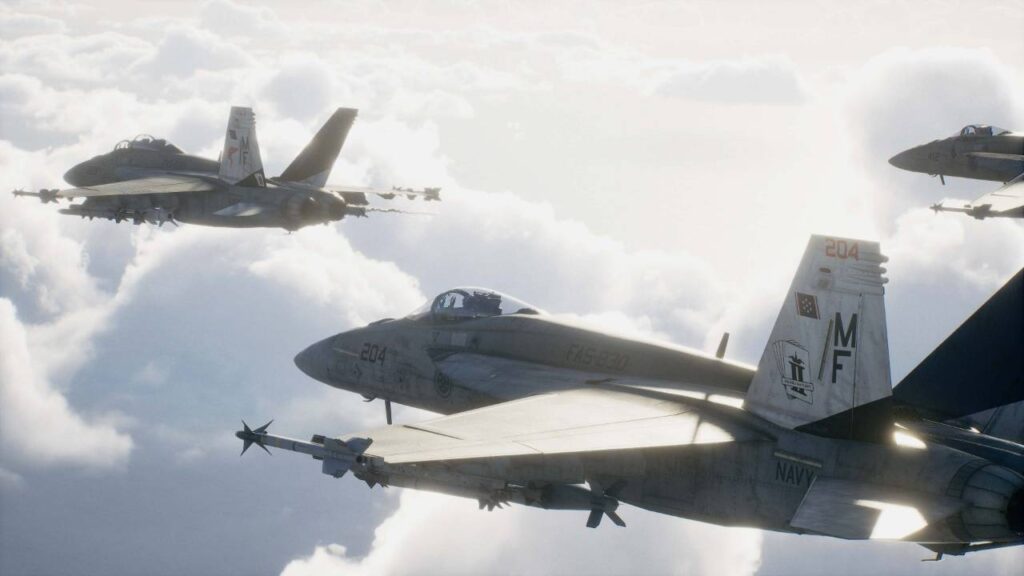
There is something wonderfully uncomplicated about an Ace Combat dogfight. An enemy jet crosses your path, your warning system starts shouting, and suddenly the only thing that matters is whether you can get a missile lock before the other pilot disappears into the clouds.
Ace Combat 8: Wings of Theve understands that feeling. Based on the available critical coverage, Bandai Namco Aces has delivered one of the series’ most confident interpretations of arcade aerial combat. Its aircraft feel more substantial, its battlefields are spectacular, and its missions give players plenty of reasons to push their flying skills further.
But the game has bigger ambitions than excellent dogfights. It wants players to care about the people aboard an aircraft carrier, the consequences of a fictional war, and the burden of becoming a symbol of hope. Some critics find that expanded storytelling surprisingly effective; others think the cinematic sequences slow down an experience that is at its best when the engines are roaring.
The flying is still the main attraction
Ace Combat has never needed to become a realistic flight simulator to make aircraft exciting. Its appeal comes from turning complicated aerial warfare into something dramatic, readable, and immediately satisfying. Ace Combat 8 builds on that identity rather than abandoning it.
PC Gamer’s review highlights weightier aircraft handling, more dangerous cloud cover, and aerial encounters that emphasize chasing opponents instead of relying on familiar turning maneuvers. Making a fighter jet feel heavier without making it frustrating is a difficult balance, particularly in a series that thrives on accessibility and exaggerated action.
The challenge isn’t simply making the player fight harder. It’s creating opponents and environments that reward more deliberate decisions. A useful dogfight should feel like a contest of positioning, speed, timing, and opportunity. When those systems come together, winning means understanding why an attack worked, not merely watching an enemy disappear.
The expanded variety of threats reinforces that idea. Enormous targets, dangerous rival squadrons, and missions combining traditional engagements with large-scale encounters give the familiar systems more room to develop. Game Informer particularly praises the rival pilots of Lux Lunae, whose presence makes aerial combat feel more personal. A difficult enemy is one thing. A recognizable opponent whose arrival changes the atmosphere of a mission is considerably more memorable.
A campaign that wants you to care about the war
Ace Combat 8 takes place in Strangereal, the series’ fictional world, where the Federation of Central Usea faces an invasion by the Republic of Sotoa. The player’s journey centers on the aircraft carrier Endurance and the identity of the Wings of Theve, a legendary fighter pilot whose reputation has become a source of hope for a nation struggling to survive.
There’s a compelling premise underneath the military spectacle: what happens when people desperately need a hero, but the story surrounding that hero isn’t entirely true? Bandai Namco uses that question to explore propaganda, identity, responsibility, and the relationships between pilots and the people depending on them.
According to the official game description, the Endurance becomes both a surviving military asset and a home for people displaced by the conflict. The game also replaces much of the older series’ limited cinematic presentation with more elaborate first-person sequences, placing the player closer to the ship’s crew between missions.
On paper, that could help Ace Combat’s storytelling catch up with its extraordinary action. The critical response, however, is far from unanimous. GamesRadar+ finds the relationships and dramatic moments surprisingly engaging, arguing that the expanded narrative strengthens the campaign. TechRadar reaches a different conclusion, praising the aerial combat while criticizing lengthy cutscenes and a story that does not always justify the time it demands.
Both reactions can make sense. A player invested in the Endurance’s crew may welcome an opportunity to understand the people behind the missions. Someone looking primarily for high-speed aircraft combat might see those same sequences as interruptions. The real question isn’t whether Ace Combat should tell stories. It always has. It’s whether the narrative creates enough emotional momentum to justify slowing the player down.
Mission variety gives the campaign its momentum
Whatever players think about the story, the available reviews agree on one important point: the campaign gives the flying plenty of opportunities to shine. The missions feature changing threats, dramatic aerial encounters, and spectacular military hardware that has long defined the franchise.
Huge enemy weapons offer something beyond conventional fighter-to-fighter engagements. They create situations where identifying weak points, managing positioning, and surviving overwhelming firepower become central to the challenge. There’s also a difference between visual variety and meaningful mechanical variety. A mission can look incredible and still become repetitive if the player approaches every objective in exactly the same way.
Ace Combat 8 appears to understand that risk. Broader aircraft roles, shifting conditions, and varied combat scenarios encourage different approaches. Push Square praises the campaign’s variety and presentation, while Game Informer identifies replayability as a strength. The more interesting measure of mission design is not whether every objective is completely new. It’s whether familiar mechanics continue creating satisfying situations.
Beautiful skies, and presentation that matters to gameplay
It would be difficult to discuss Ace Combat 8 without mentioning its clouds. Dynamic weather and elaborate cloud formations have become an important part of the series’ visual identity, and the latest game pushes that spectacle further. But clouds aren’t merely decoration. When weather affects visibility and positioning, the environment becomes part of the fight.
TechRadar highlights the environmental visuals, while PC Gamer describes weather as part of the improved aerial experience. Sound deserves attention too. Ace Combat’s music carries a remarkable amount of its drama, making a difficult engagement feel desperate or a rival pilot genuinely threatening. GamesRadar+ is especially enthusiastic about the soundtrack’s contribution to major encounters.
There are technical reservations. PC Gamer reports occasional hitching and smaller PC issues in its review environment. Push Square notes some softness and blurry textures on a standard PS5, despite praising the overall smoothness. Those are findings from particular configurations, not universal problems across every platform or subsequent update. Players sensitive to image clarity or performance consistency should check current platform-specific reports.
Multiplayer offers more to do, with complications
Ace Combat 8 makes a substantial effort to expand its online experience. According to Bandai Namco’s multiplayer overview, Ace Combat Online has progression separate from the single-player campaign. Players can participate in different operations, develop aircraft, and engage with a broader structure that includes cooperative and competitive activities, with cross-platform online play.
That’s meaningful for players who want the flight mechanics to remain relevant after the campaign ends. But there’s a difference between offering more progression and making that progression enjoyable. Game Informer praises the online activities while pointing to aircraft upgrade grinding, cumbersome menus, and cosmetic monetization as interruptions to an otherwise strong experience.
Push Square found the online offerings promising, although its pre-release access was too limited to judge long-term progression. GamesRadar+ likewise had limited online access during the review period. A handful of sessions can reveal whether dogfights are enjoyable, but not how matchmaking, progression, or content variety hold up over months.
The Premium Ace Pass adds another consideration. Bandai Namco confirms that the pass includes aircraft-related content, cosmetics, and progression rewards, while stating that the game does not use paid loot boxes. That distinction is useful, but it does not settle questions about value or how smoothly multiplayer works without additional purchases. Players who dislike layered progression may find online play more complicated than the campaign’s straightforward aerial action.
Who should consider Ace Combat 8?
Ace Combat 8 appears to be a strong choice for players who enjoy arcade flight combat, dramatic encounters, and campaigns built around increasingly spectacular challenges. Aircraft handling, mission variety, rival squadrons, visuals, and music form a convincing combination. It also seems welcoming to players who aren’t interested in the technical demands of a full flight simulator.
The recommendation becomes more complicated for anyone who wants nonstop action. Expanded storytelling asks for patience, particularly when the campaign moves away from the cockpit. Whether that patience is rewarded depends on how much you connect with the characters and the game’s dramatic direction. Multiplayer enthusiasts should also consider progression systems and monetization before assuming online play offers the same immediacy as the campaign.
Verdict: A superb flight game with ambitions that won’t please everyone
Ace Combat 8: Wings of Theve understands why people love this series. Its flying is exhilarating, major encounters memorable, and presentation gives aerial combat an extraordinary sense of scale. Independent assessments point to a sequel that refines its core mechanics without sacrificing the outrageous spectacle that makes Ace Combat special.
Its expanded storytelling is more divisive. Some critics find a surprisingly affecting war story beneath the action; others see cinematic ambition that occasionally slows the experience when it should be accelerating. Neither reaction undermines the quality of the dogfights, but both reveal something useful about the game’s priorities.
If you’re coming for spectacular aerial combat, Ace Combat 8 makes a compelling case for itself. If you want every moment focused on flying, the heavier narrative and online progression may test your patience. Its most convincing achievement isn’t that it has become bigger or more cinematic. It’s that its best moments still come from a fighter jet, an impossible target, and a few seconds to make everything count.