
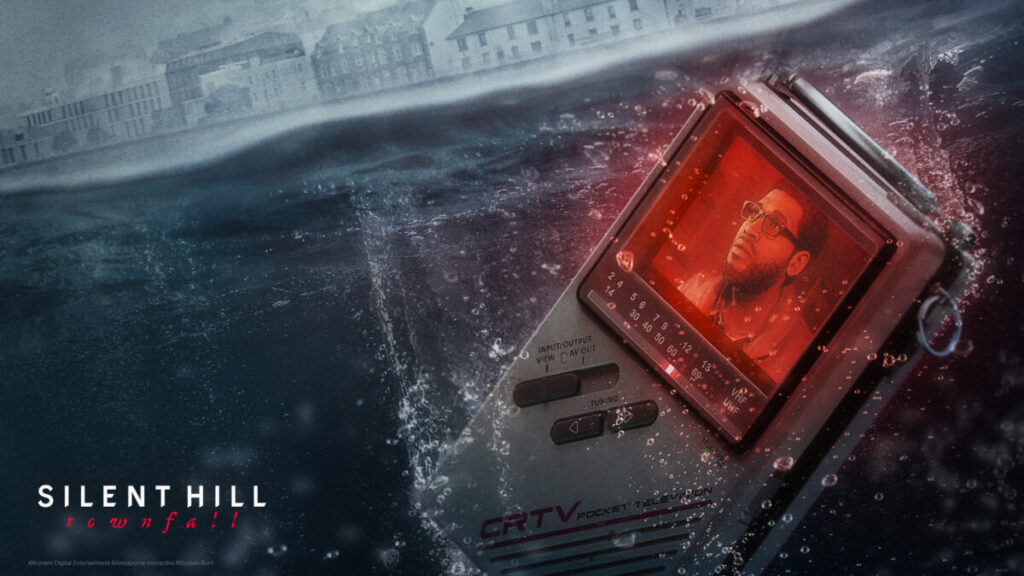
Silent Hill doesn’t need its old address to feel like Silent Hill
There’s an obvious risk in moving a long-running horror series away from the place that gave it its name. A new town, a new protagonist, a first-person camera: change enough, and you might end up with an atmospheric horror game that happens to have the Silent Hill logo on its box. Silent Hill: Townfall is interesting precisely because the available evidence points in the other direction. Its unfamiliar setting seems to sharpen, rather than dilute, the series’ fascination with guilt, memory and places that seem to know too much about the people walking through them.
Developed by Scottish studio Screen Burn Interactive, Townfall follows Simon Ordell to St Amelia, a fictional island community off the Scottish coast. Konami confirmed its September 24 release on PS5 and PC, and describes it as the franchise’s first full-length entry told entirely in first person. That shift isn’t cosmetic. It changes how a player reads a corridor, watches a doorway and decides whether to investigate the next unpleasant sound. Konami’s launch announcement lays out the setting and basic premise.
This is a research-based Critical Overview, drawing on official material and published hands-on reviews. Reespawn has not independently played or tested Townfall. That distinction matters here because the sharpest disagreement among critics is not about whether the place feels disturbing. It is about whether the mechanics that sustain that disturbance remain enjoyable.
A Scottish town with a personality of its own
One thing reviewers repeatedly recognize is the conviction behind St Amelia. The fog is familiar Silent Hill vocabulary, but the details around it are different: coastal architecture, ordinary civic spaces and the visual texture of a community whose history feels specific. Horror works particularly well when a place seems to have existed before the player arrived. Instead of constructing a sequence of rooms that exist only to deliver shocks, Townfall builds unease from recognizable surroundings and the suggestion that everyday life has been interrupted.
PC Gamer’s review praises the environmental storytelling and the island’s sense of identity. VGC similarly singles out the authentic detail of the Scottish setting, even while being much less forgiving of the gameplay. That agreement is informative: the game’s strongest foundation appears to be its world, rather than nostalgia for the series’ older locations.
The move to first person reinforces that quality. A shop front, an abandoned street or a quiet domestic interior can demand closer inspection when the camera stays at eye level. It also removes some of the emotional distance that third-person horror can provide. But immersion cuts both ways: a tense encounter becomes more immediate, while an annoying one can become harder to shrug off. That tension runs through the game as a whole.
The little television is more than a gimmick
Townfall’s distinctive device is the CRTV, a handheld television-like tool that allows the player to observe threats and interpret signals. In official previews, Screen Burn positioned it as an evolution of the series’ warning-radio tradition. Rather than simply alerting players that something awful is nearby, the device becomes part of navigating dangerous spaces and solving environmental problems. The studio discussed that design in its PlayStation Blog gameplay reveal.
This is the sort of mechanic that can justify a sequel’s new perspective. An ordinary inventory tool is useful; a tool that teaches players to read the world differently changes how the whole game operates. PC Gamer treats the CRTV as a standout feature, describing how monitoring enemies and interpreting incomplete information made stealth encounters feel like puzzles. Its limitations also matter: information can be imprecise, and juggling signals makes it less than an all-seeing safety device.
There is a coherent design idea underneath that inconvenience. Horror needs uncertainty, but random surprise is not always satisfying. A device that provides partial knowledge gives players some responsibility for their mistakes without making danger predictable. If Townfall works for a player, it may be because the CRTV turns fear into a problem to manage rather than an obstacle to endure.
When tension becomes friction
That last point is where the critical conversation splits. VGC’s review praises the atmosphere but criticizes sections of stealth as frustrating. GamesRadar+ also emphasizes how slow and punishing the game can be, although its overall response is more admiring. Meanwhile, PC Gamer finds considerable satisfaction in using observation and caution to bypass danger.
Those views aren’t necessarily contradictory. They describe two possible reactions to the same design priority. Players who like deliberate, vulnerable horror may appreciate being asked to stop, listen and plan. Someone who needs consistent forward momentum may experience the same restrictions as busywork, particularly after repeated failed attempts. That is a useful distinction for readers, and more revealing than declaring the stealth universally good or bad.
Combat exists, but the available reviews suggest Townfall is not built around making Simon a confident monster hunter. Survival often depends on how effectively a player gathers information and chooses when not to fight. If you’re drawn to the series for its action, this emphasis deserves consideration. If you prefer horror that makes evasion part of its storytelling, the restraint may be a strength.
Puzzles that respect attention—and sometimes test patience
Environmental puzzles are another major part of Townfall’s identity. Early challenges appear to teach players to search notes, interpret details and connect clues rather than hunt for glowing markers. The strongest examples make the environment feel like something to understand rather than a sequence of locks to open. They also complement the game’s slower pace: careful examination becomes a form of participation in the mystery.
However, reviewers point to late-game challenges that can feel unnecessarily opaque. PC Gamer mentions a particularly involved puzzle using directional clues, while Tom’s Guide also identifies a puzzle as a major weak spot in an otherwise positive assessment. A difficult puzzle is not automatically a flawed one; the important question is whether the game gives players enough to reason toward a solution. Townfall appears to occasionally cross that line for critics who otherwise admire its design.
That makes the audience question fairly straightforward. If you’re comfortable sitting with uncertainty, trying an interpretation and returning to examine the clues, there is a lot to enjoy. If opaque puzzles feel like interruptions rather than part of horror’s rhythm, this may be the kind of game where the mood survives better than your patience.
A story worth protecting from spoilers
Townfall’s narrative is closely tied to Simon and the island’s past. Most of the professional coverage is careful about revealing major events, and that restraint is worth preserving. What can be discussed without ruining the mystery is the structure: an outsider returns to a place full of unfinished emotional business, and ordinary details gradually take on uncomfortable meaning.
TechRadar’s PS5 review finds the narrative intriguing even though its emotional payoff takes time. GamesRadar+ considers the story more challenging and lingering than a conventional horror plot. In contrast to an experience where each scary sequence exists as a separate attraction, the appeal here seems to come from the connections between setting, memory and the protagonist’s uneasy relationship to both.
It is tempting to sell that as a guarantee of psychological depth. Better to say the available evidence supports an ambitious and deliberately paced narrative, with a conclusion that has generated thoughtful responses. Whether it resonates is likely to depend on a player’s willingness to accept ambiguity.
Presentation, performance and the practical decision
Visual direction is among Townfall’s best-supported strengths. Reviewers across PS5 and PC praise the environmental art and atmosphere, though some call out stiff facial animation or less memorable enemy designs. That difference matters: strong art direction can make a game haunting without every animation or creature looking equally convincing.
Platform reports should also be kept separate. Tom’s Guide reports a few technical issues on its PS5 review setup, while TechRadar reviewed on PS5 and PC Gamer on a midrange desktop configuration. These are individual review experiences, not benchmark-wide claims. We have not independently verified a post-launch patch history, so it would be misleading to assert that all launch problems are fixed—or that they persist unchanged today.
Townfall also seems designed for a relatively focused playthrough rather than a sprawling open world. PC Gamer reports finishing in roughly 13 hours. That’s one reviewer’s completion time, not a universal promise, but it gives useful context for players weighing a concentrated horror narrative against something they can inhabit for months.
The verdict: a strong new location, with deliberately difficult company
Silent Hill: Townfall appears to be a compelling choice for players who value atmosphere, exploration and psychological uncertainty more than frictionless progression. Its first-person perspective and CRTV system have a clear purpose: they make observation itself feel tense. St Amelia seems memorable not because it copies a famous fictional town, but because it has its own unsettling character.
The tradeoff is real. Stealth can become exasperating, some puzzles push beyond satisfying difficulty, and anyone expecting frequent combat may be surprised by how much of the experience revolves around caution. Those aren’t small caveats; they’re the very mechanics through which the game delivers its horror.
For patient survival-horror fans, this looks like a worthwhile reinvention. For players who prefer brisker pacing or more forgiving encounters, the same design may be a reason to hesitate. Townfall’s most persuasive achievement is that the conversation around it concerns a distinctive game with identifiable strengths and weaknesses—not merely the return of a familiar brand.